Monetization | Martech Blog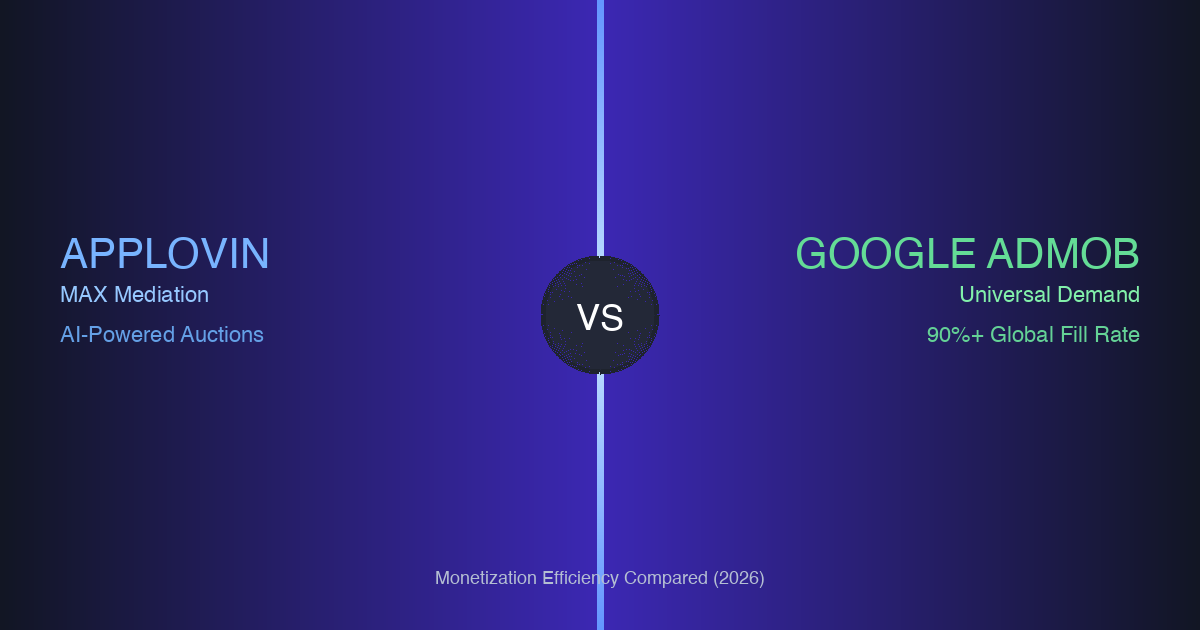
If you are running a mobile app in 2026 and monetizing through advertising, you have almost certainly faced the question: AppLovin or AdMob? It is the monetization equivalent of iOS versus Android — two fundamentally different platforms, each with fiercely loyal advocates, and each with structural advantages that the other cannot easily replicate.
The answer, as with most non-trivial engineering decisions, is not a binary choice. It depends on what you are building, where your users are, and how much operational complexity you are willing to absorb. But the market has shifted dramatically over the past eighteen months, and the calculus that might have made sense in 2024 looks very different today.

Pure Bidding vs. Waterfall: The Monetization Efficiency Frontier in 2026
1. Introduction: The Paradigm Shift
The programmatic advertising ecosystem has undergone a fundamental transformation over the last decade. What began as a simple “waterfall” mechanism to manage remnant inventory has evolved into a sophisticated, high-frequency auction environment. For product leaders and ad-tech engineers, the choice between “Pure Bidding” (Header Bidding) and the traditional “Waterfall Model” is no longer just a technical preference—it is a strategic decision that directly dictates the revenue ceiling and the long-term health of a publisher’s monetization stack.
Introduction
The mobile landscape in 2026 is witnessing a seismic shift in content consumption. Short drama apps—platforms offering bite-sized, high-production-value serialized vertical videos—have exploded into the mainstream. As these apps scale globally, developers and product leaders face a critical challenge: how to effectively monetize a massive, highly engaged user base without compromising the viewing experience. While in-app purchases (IAP) were the initial backbone of the industry, the rise of ad-supported models (IAA) and sophisticated hybrid strategies is now the key to unlocking maximum revenue potential.

In the hyper-competitive ecosystem of 2026 mobile advertising, the margin between a profitable publisher and one struggling for survival often resides in the micro-optimizations of the mediation layer. The industry has witnessed a seismic shift in how ad inventory is valued and sold. We have moved decisively away from the era of the sequential, opaque “waterfall” toward a more sophisticated, simultaneous, and unified auction architecture. For the modern mobile publisher, the challenge is no longer just about finding demand; it is about managing the complex interplay between bid density, auction latency, and the algorithmic nuances of bid shading.

Beyond the Hype: The Structural Shift in IAA
If you’ve spent your career in the trenches of programmatic advertising—building bid-shifters, optimizing SSP waterfalls, or managing high-volume DSPs—you know that the “efficiency” of In-App Advertising (IAA) has historically been a game of marginal gains. We fought for 1% improvements in latency, 2% lifts in fill rate, and 5% drops in CPA.
But as we navigate through 2026, we aren’t looking at marginal gains anymore. We are looking at a structural rewrite of the entire monetization stack, driven by Generative AI (GenAI).
The End of Single-Stream Revenue: A Technical Reckoning
If you’ve spent the last decade building Demand-Side Platforms (DSPs) or architecting the backend for global mobile game economies, you’ve witnessed the rise and fall of “pure” monetization models. There was a time when you could build a business on 100% In-App Advertising (IAA) or a 100% In-App Purchase (IAP) “whales-only” strategy.
As we cross into mid-2026, those days are officially behind us. The “Single-Stream Revenue” era has ended, not because developers wanted it to, but because the underlying economics of the mobile ecosystem have fundamentally broken.