Ad-Tech | Martech Blog
The Takeaway in One Line: This was a two-story quarter. Meta’s advertising engine accelerated past expectations, posting a revenue beat against elevated expectations — yet the stock fell as much as 10% after hours on cratering profit, vanishing free cash flow, and a softer-than-expected Q3 guide. The market sold the AI capex story, not the ads story. Advertisers need to read both.
Let’s correct the most common misread right at the top: advertising revenue did not miss expectations. It beat them.
The Privacy Revolution: What Changed and Why
The advertising industry has operated on a simple premise for nearly two decades: track users across the web, build behavioral profiles, and serve them personalized ads based on their browsing history. It was effective. It was pervasive. And it turned out to be unsustainable.
The privacy revolution didn’t happen overnight. It was the convergence of three powerful forces, each reinforcing the others.
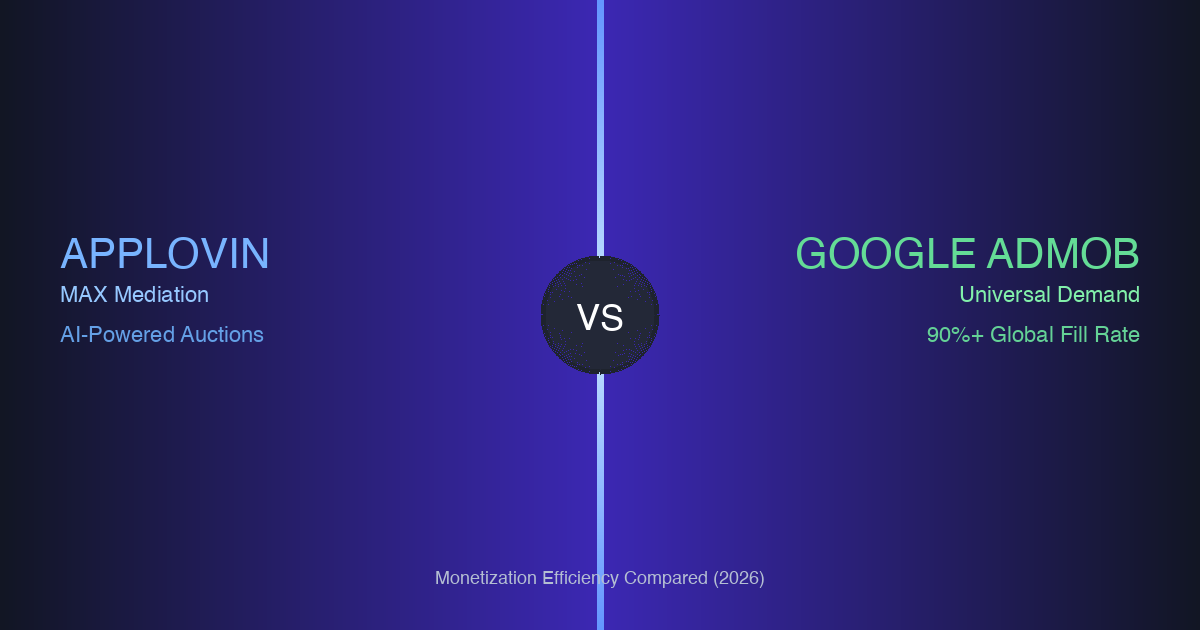
If you are running a mobile app in 2026 and monetizing through advertising, you have almost certainly faced the question: AppLovin or AdMob? It is the monetization equivalent of iOS versus Android — two fundamentally different platforms, each with fiercely loyal advocates, and each with structural advantages that the other cannot easily replicate.
The answer, as with most non-trivial engineering decisions, is not a binary choice. It depends on what you are building, where your users are, and how much operational complexity you are willing to absorb. But the market has shifted dramatically over the past eighteen months, and the calculus that might have made sense in 2024 looks very different today.

Pure Bidding vs. Waterfall: The Monetization Efficiency Frontier in 2026
1. Introduction: The Paradigm Shift
The programmatic advertising ecosystem has undergone a fundamental transformation over the last decade. What began as a simple “waterfall” mechanism to manage remnant inventory has evolved into a sophisticated, high-frequency auction environment. For product leaders and ad-tech engineers, the choice between “Pure Bidding” (Header Bidding) and the traditional “Waterfall Model” is no longer just a technical preference—it is a strategic decision that directly dictates the revenue ceiling and the long-term health of a publisher’s monetization stack.
Introduction
The mobile landscape in 2026 is witnessing a seismic shift in content consumption. Short drama apps—platforms offering bite-sized, high-production-value serialized vertical videos—have exploded into the mainstream. As these apps scale globally, developers and product leaders face a critical challenge: how to effectively monetize a massive, highly engaged user base without compromising the viewing experience. While in-app purchases (IAP) were the initial backbone of the industry, the rise of ad-supported models (IAA) and sophisticated hybrid strategies is now the key to unlocking maximum revenue potential.

In the hyper-competitive ecosystem of 2026 mobile advertising, the margin between a profitable publisher and one struggling for survival often resides in the micro-optimizations of the mediation layer. The industry has witnessed a seismic shift in how ad inventory is valued and sold. We have moved decisively away from the era of the sequential, opaque “waterfall” toward a more sophisticated, simultaneous, and unified auction architecture. For the modern mobile publisher, the challenge is no longer just about finding demand; it is about managing the complex interplay between bid density, auction latency, and the algorithmic nuances of bid shading.

The Chinese digital advertising landscape in 2026 has moved beyond the era of simple programmatic efficiency into a new paradigm of autonomous, high-concurrency, and privacy-centric intelligence. For the leadership of an AI-driven Demand-Side Platform (DSP), understanding this shift is not merely about observing trends; it is about recognizing a fundamental architectural transformation. The transition from “search-based” advertising to “discovery-based” commerce—powered by the convergence of Agentic AI and closed-loop ecosystems—has redefined the requirements for real-time bidding (RTB), creative optimization, and data utility.

Beyond the Hype: The Structural Shift in IAA
If you’ve spent your career in the trenches of programmatic advertising—building bid-shifters, optimizing SSP waterfalls, or managing high-volume DSPs—you know that the “efficiency” of In-App Advertising (IAA) has historically been a game of marginal gains. We fought for 1% improvements in latency, 2% lifts in fill rate, and 5% drops in CPA.
But as we navigate through 2026, we aren’t looking at marginal gains anymore. We are looking at a structural rewrite of the entire monetization stack, driven by Generative AI (GenAI).

The Death of the “One-Tap Wonder”: A Veteran’s Perspective
If you were in the trenches of the mobile ad-tech world circa 2018-2020, you remember the “Golden Age” of hyper-casual. We were building DSPs designed to ingest millions of events per second from games that were, quite frankly, little more than a core mechanic wrapped in a SDK. The math was simple, elegant, and incredibly profitable: buy users at $0.20 CPI, show them ten ads in a three-day retention window, and pocket the $0.10 margin. Scale that by ten million installs, and you had a unicorn.

The Sunset of Stealth: Navigating the Privacy-First Reality
If you’ve spent any time in the trenches of ad-tech—building DSPs, optimizing SSP pipelines, or wrestling with attribution logic—you know that the “Post-Cookie Era” isn’t a future threat. It is our current, permanent reality. As we move deeper into 2026, the digital marketing industry has undergone a tectonic shift: we have moved from the era of passive, “stealth” tracking to a world defined by explicit consent and privacy-by-design.

Introduction: The Death of the "Campaign"
In early 2026, we are witnessing the final transition of marketing from a sequence of discrete human-led campaigns to a "living" system of autonomous orchestration. We no longer just "use AI tools"; we manage Agentic AI systems that plan, execute, and iterate. For brands, the target audience is no longer just the human consumer—it is increasingly the AI Agent acting on their behalf.
1. Beyond Automation: The Rise of Agentic AI
Traditional marketing automation was "if-this-then-that." Agentic AI is "here is the goal, find the path." In 2026, marketing agents are taking on operational responsibility for entire workflows:

The Shift from Clicks to Commands
In the first quarter of 2026, we are witnessing the end of an era. For decades, digital marketing has been an “Attention Economy” designed for human eyes. We optimized for the scroll, the click, and the emotional resonance of a banner ad.
But as the “Digital Familiar”—personal AI agents that act on behalf of humans—becomes a household reality, the primary target of your marketing is no longer a human. It is an autonomous agent. Welcome to the era of Business-to-Agent (B2A) marketing.

Beyond Automation: Why Agentic AI is the Definitive DSP Trend of 2026
As we cross the first quarter of 2026, the digital marketing landscape is witnessing a tectonic shift. We are no longer just talking about “AI-assisted” tools or simple machine learning algorithms. We have officially entered the era of Agentic AI in programmatic advertising.
For modern marketing stacks, this isn’t just a feature update—it’s a fundamental reimagining of the Demand-Side Platform (DSP) for a high-velocity, privacy-first market.

The Macro Context: A Warning from the Job Market
The recent US economic data for February 2026 revealed a startling and unexpected loss of 92,000 jobs. While traditional economic analysts scramble to blame interest rates or consumer sentiment, a deeper trend is emerging within the MarTech sector. We are no longer in an era of “AI-assisted” work; we have entered the age of Autonomous Execution.
The pressure for efficiency is at an all-time high. Companies are realizing that the “Execution Gap”—the time and cost between a strategic decision and a live campaign—is the biggest leak in their marketing ROI. To plug this leak, the industry is pivoting its focus from the real human consumer to the Digital Agent.